Customers Don’t Think in Platforms
No customer has ever said:
“First, I will engage with this brand on Instagram.
Then I will transition into email.
Then I will convert on the website.”
That’s how marketers think — not how people behave.
Real customers move fluidly:
- They scroll while waiting in line
- Click something, get distracted
- Come back days later via search
- Open an email at the wrong time
- Ignore it
- Then convert weeks later after one small nudge
The journey isn’t linear.
It isn’t platform-based.
And it definitely isn’t neat.
Yet most marketing strategies are still built around channels instead of behavior. That mismatch is where blind spots, wasted budget, and stalled growth quietly creep in.
Why Customers Don’t Experience Brands in Channels
Customers don’t see “channels.”
They see moments.
Moments of curiosity.
Moments of doubt.
Moments of readiness.
Moments of hesitation.
Each touchpoint either:
- Moves them forward
- Confuses them
- Or gets ignored entirely
From their perspective, your brand is one continuous experience — not a collection of platforms run by different teams with different KPIs.
When messaging, tone, timing, and expectations shift between touchpoints, customers feel friction. And friction slows decisions.
The Problem With Channel-Based Thinking
Channel-based strategy asks questions like:
- “How is social performing?”
- “What’s our email open rate?”
- “How much traffic did the website get?”
These aren’t bad questions — they’re just incomplete.
When performance is evaluated one platform at a time:
- Teams optimize locally, not globally
- Success in one channel masks failure elsewhere
- Budget follows dashboards, not outcomes
- Strategy becomes reactive instead of intentional
You end up with:
- Social content optimized for engagement, not movement
- Emails optimized for opens, not progression
- Websites optimized for traffic, not clarity
Everything “works”… but nothing connects.
The Danger of Measuring Success One Platform at a Time
Here’s where things break down.
Scenario 1: Social Looks Strong
Engagement is up.
Reach is growing.
Content is performing.
But email signups are flat.
Website conversions aren’t moving.
Social isn’t the problem — the handoff is.
Scenario 2: Email Metrics Look Great
High open rates.
Solid click-throughs.
But those clicks don’t convert.
Or they land on pages that don’t match the message.
Email did its job. The journey didn’t.
Scenario 3: Website Traffic Is Climbing
Analytics look healthy.
Traffic charts point up.
But leads are low quality.
Sales feels no lift.
Traffic without intent is just noise.
In each case, channel-level success hides journey-level friction.
What Journey-Level Data Reveals That Channel Metrics Can’t
When you shift your lens from platforms to paths, the insight gets sharper.
Journey-level data shows:
- What people see before they convert
- Which messages appear repeatedly in winning journeys
- How long decisions actually take
- Where momentum slows or breaks
- Which channels influence action without “closing”
You start seeing:
- Patterns instead of snapshots
- Influence instead of attribution
- Flow instead of performance
This is where smarter strategy lives.
Influence, Timing, and Intent: The Three Things That Actually Matter
Influence
Which touchpoints shape perception early?
Which channels quietly build trust?
These often don’t convert — but without them, nothing does.
Timing
When do people actually act?
Immediately? Days later? Weeks later?
Journey data reveals when pressure works — and when patience does.
Intent
What signals readiness?
Page depth? Email clicks? Content consumption? Repeat visits?
Intent is rarely revealed by one channel alone. It emerges across touchpoints.
What Changes When You Optimize for Flow Instead of Platforms
This is the shift most brands need — and few make.
When you optimize for flow:
- Messaging becomes more consistent
- Content is designed to lead somewhere
- Channels support each other instead of competing
- Budget allocation becomes clearer
- Customer experience improves naturally
You stop asking:
“Which platform is winning?”
And start asking:
“Where does the journey slow down — and why?”
That’s a much more powerful question.
Simple Ways to Start Thinking in Journeys, Not Silos
You don’t need enterprise software or complex attribution models to begin this shift.
Here’s how to start today.
1. Map the Journey From the Customer’s Point of View
Not your org chart.
Not your tools.
Ask:
- How do people usually find us?
- What do they see next?
- What questions do they have?
- Where do they hesitate?
- What finally pushes them to act?
2. Identify the Role of Each Channel
Instead of ranking channels, define their job:
- Awareness
- Education
- Nurture
- Conversion
- Reinforcement
Channels can share roles — but they shouldn’t be undefined.
3. Look for Friction Between Touchpoints
Check transitions:
- Social → Website
- Email → Landing page
- Content → CTA
- Ad → Follow-up
If the experience feels disjointed, customers feel it too.
4. Align Metrics to the Journey
Instead of isolated KPIs, track:
- Movement between stages
- Drop-off points
- Time to conversion
- Lead quality over time
This turns reporting into insight.
5. Review Performance Holistically
Monthly reviews should answer:
- What helped people move forward?
- What slowed them down?
- What channels worked better together?
This keeps strategy grounded in reality — not dashboards.
Why This Shift Matters More Than Ever
Customer behavior keeps getting more fragmented.
Platforms keep changing.
Attention keeps shrinking.
The brands that win won’t be the ones with the most channels — they’ll be the ones with the smoothest journeys.
When your strategy mirrors how customers actually behave, marketing feels easier, clearer, and more effective.
And most importantly — it stops feeling like guesswork.
Final Thought + CTA: Stop Managing Platforms. Start Guiding Journeys.
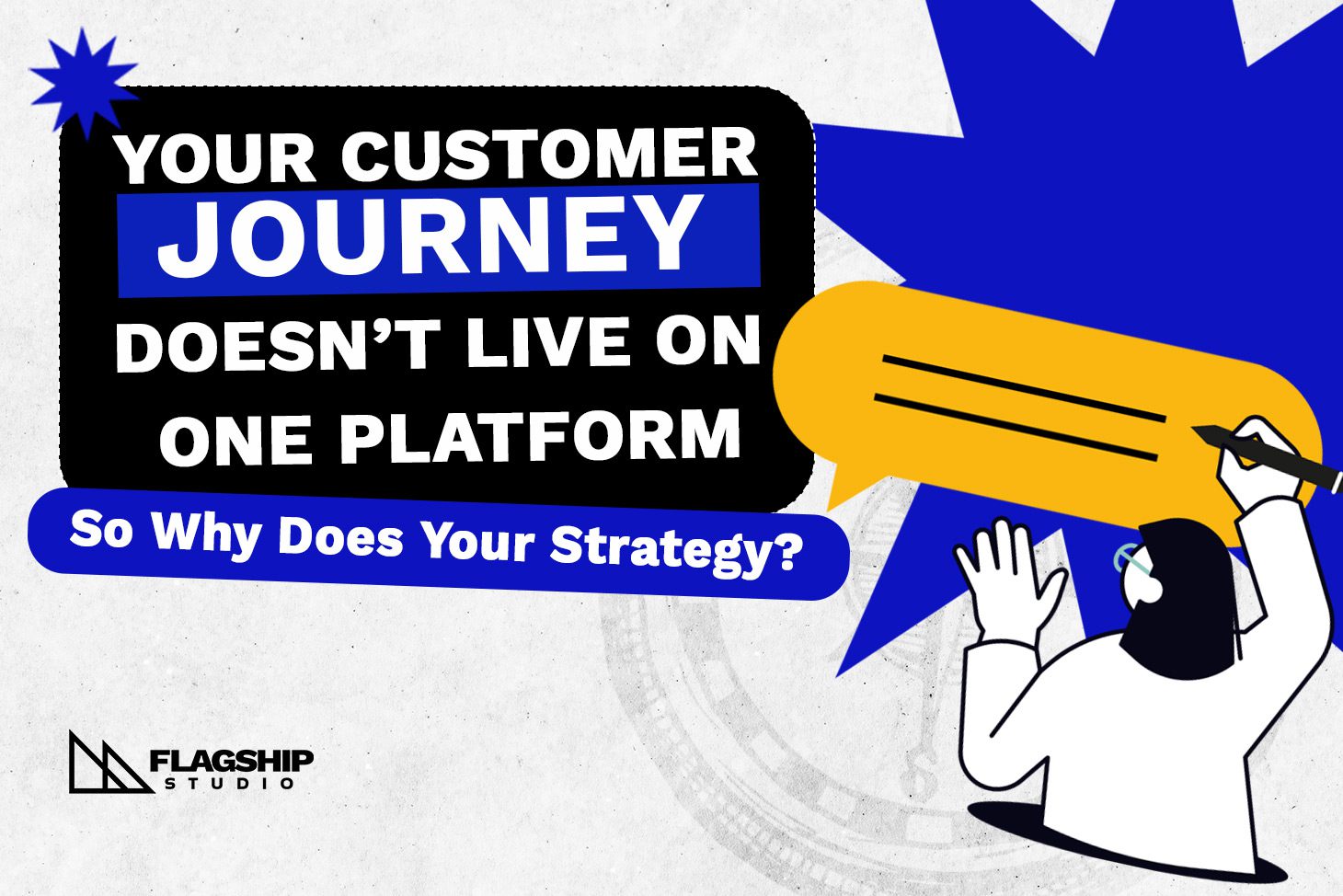
Your customer journey doesn’t live on one platform.
It lives in the moments between them.
If your strategy is still built around isolated channels, you’re only seeing part of the picture — and making decisions with incomplete information.
At Flagship Studio, we help brands shift from platform-first thinking to journey-first strategy — connecting touchpoints, aligning messaging, and turning fragmented data into real insight.
📞 Book a free strategy call
Let’s map your customer journey the way your customers actually experience it.