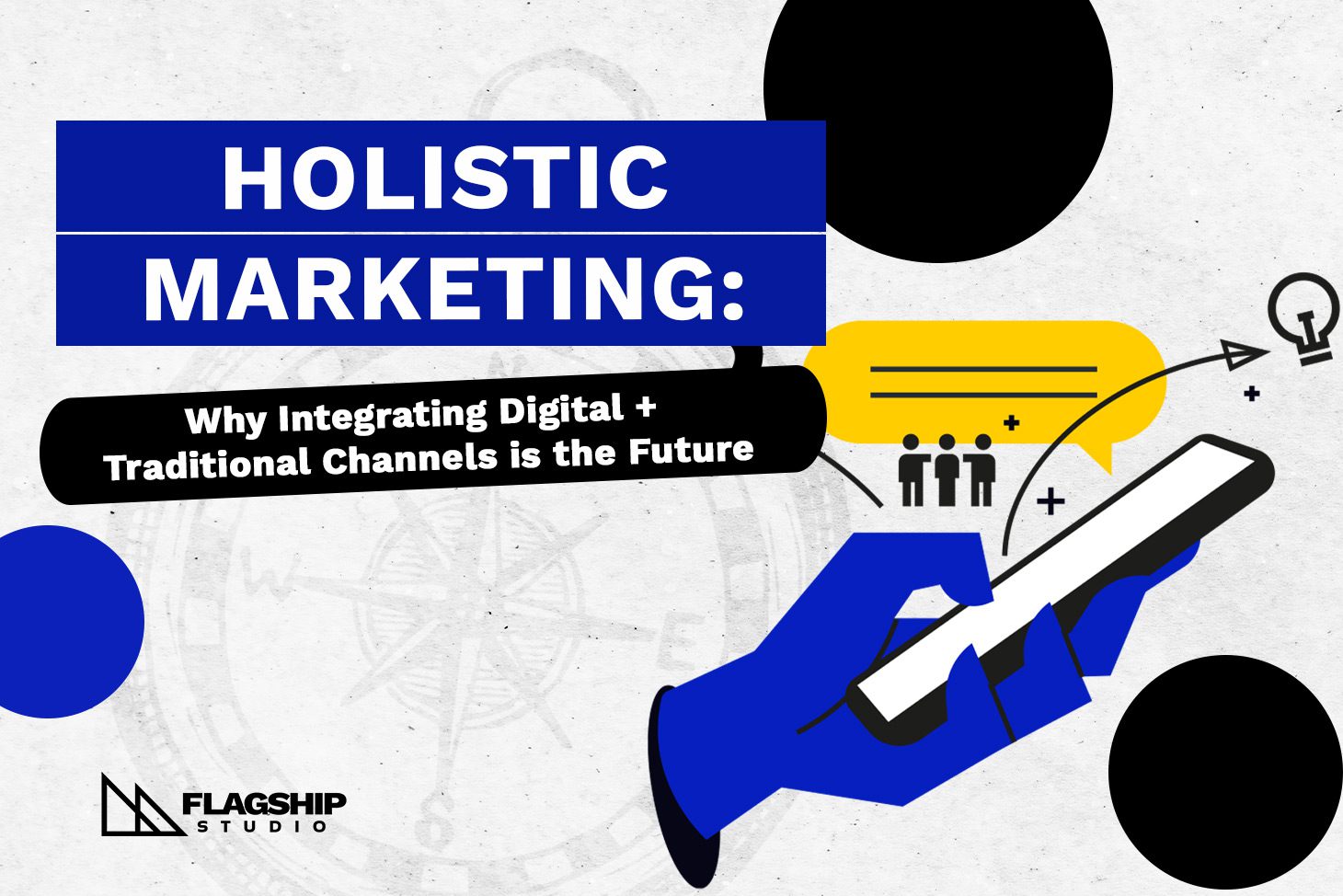
Two Sides of the Same Compass
A funny thing happens when you talk to businesses about marketing:
They’ll tell you all about their digital efforts — social, SEO, ads — and then, almost as an afterthought, they mention the print materials, events, trade shows, postcards, radio, or local sponsorships they’re also doing.
It’s like watching someone proudly show off their left hand while pretending the right hand isn’t doing anything important.
At Flagship Studio, we make this pretty simple:
We navigate both digital and traditional marketing waters — because smart brands don’t pick one ocean to sail.
But most companies do.
And that separation is where the leaks start.
Digital and traditional shouldn’t be two teams running separate races. They should be rowing in sync — same message, same brand energy, same strategic direction.
When they’re siloed, you lose consistency, you lose momentum, and you lose money.
When they’re integrated, everything gets sharper, clearer, and more effective.
Let’s dig into why the future belongs to brands that think holistically — not in disconnected channels.
Why Companies Silo Their Marketing (and Why It Backfires)
Most brands don’t split digital and traditional on purpose. It usually happens because of structure:
- One team “owns digital,” one handles print or events.
- Vendors are hired for different functions with no shared strategy.
- Leadership sees them as different disciplines instead of the same messaging expressed in different mediums.
The result?
Two sets of campaigns… two sets of KPIs… two sets of brand interpretations.
It’s like giving two captains their own maps and just hoping the ships meet at the destination.
Where siloing hurts you:
1. Brand inconsistency
Different designers, agencies, or internal teams →
different visuals, different wording, different tone.
The audience doesn’t think “Oh, this must be the print version.”
They think:
“Why does this brand feel different every time I see it?”
2. Wasted budget
Digital might drive awareness.
Traditional might drive credibility.
But without a shared plan, you’re paying for two isolated machines when one engine would be more powerful.
3. Confusing customer journeys
Someone may see:
- a billboard
- then a social ad
- then a Google search result
- then a postcard
- then your website
If each touchpoint feels like it came from a different company, trust drops. Engagement drops. Conversion drops.
4. Missed data insights
Digital gives you the “what.”
Traditional often gives you the “who” and “why.”
If those insights don’t talk to each other, you’re making decisions with half the story.
Why Holistic Marketing Wins (Now and in the Future)
When your traditional and digital channels operate under one unified strategy, everything works harder.
1. Consistent Messaging Everywhere
Your brand sounds like one voice — not three versions of the same idea.
That confidence builds trust, and trust fuels sales.
2. Compounding Touchpoints
The average buyer now needs 8–15 interactions before taking action.
A holistic strategy means:
- Your mailer matches your landing page.
- Your trade show booth ties into your social content.
- Your Google ads echo the messaging in your printed one-sheet.
Those combined moments make your brand feel credible and intentional.
3. Better ROI Across All Channels
When everything supports everything else, the lift multiplies.
Digital amplifies traditional.
Traditional reinforces digital.
You stop guessing and start compounding.
4. A Strategy Built for Real Behavior
People don’t live in “digital” or “traditional.”
They live in a blend of both.
They scroll on phones.
They drive past signage.
They listen to radio in the car.
They check their email at breakfast.
They see a postcard on the counter.
A holistic approach matches how real humans move through their day.
How to Evaluate Whether Your Marketing Is Siloed (Quick Audit)
Grab a notebook. Here’s the Flagship Studio “Silo Check.”
1. Are your campaigns planned together or separately?
If digital meets on Tuesdays and traditional meets on Thursdays, that’s a problem.
2. Does your print messaging match your website?
Tone, visuals, wording — not similar… identical.
3. Are your KPIs unified or channel-specific only?
If each platform has its own scoreboard, you’re measuring activity, not impact.
4. Do your vendors talk to each other?
If not, they should — or better yet, you should have one integrated marketing team.
5. Does your audience journey connect across channels?
Example:
Someone scans a QR code on your flyer → goes to a landing page → joins a list → receives a follow-up email.
No? That’s siloing.
If even two of these hit home, you’re running parallel tracks instead of a unified system.
How to Start Integrating Digital + Traditional (A Tactical, Real-World Playbook)
You don’t need to rebuild everything tomorrow.
Integration happens through small, strategic steps.
Step 1: Build One Master Messaging Guide
This is your north star.
It should include:
- Core value propositions
- Tone of voice
- Visual guidelines
- Approved headlines
- CTAs
Everything else flows from this.
Step 2: Align Digital & Traditional Calendars
Stop running two calendars. Combine them into:
- One master content plan
- One campaign theme per month
- Cross-channel touchpoints supporting the same idea
When your print piece, blog post, and paid ad all aim at the same goal, the impact skyrockets.
Step 3: Bridge Your Offline and Online Channels
Use tools that connect traditional to digital:
- QR codes
- URL redirects
- Trackable phone numbers
- Landing pages built specifically for offline campaigns
- Retargeting ads for trade show visitors
- Social campaigns tied to event promotions
A postcard shouldn’t end at the mailbox.
It should move someone directly into your digital ecosystem.
Step 4: Standardize Your Visual Identity
Every piece — whether it’s a billboard or a carousel post — should feel like it came from the same designer.
If it doesn’t, it’s time for a brand refresh or a proper brand guide.
Step 5: Use One Team or One Captain
This is the reason Flagship Studio’s Fractional Marketing Department works so well.
Instead of:
- A print vendor
- A web developer
- A social media freelancer
- An SEO contractor
- An in-house marketing assistant
…you get one holistic crew steering the entire ship — digital and traditional together.
Metrics That Matter in a Holistic Strategy
Here’s what to watch once your channels are aligned:
1. Multi-Touch Attribution
Look at all the interactions leading to a conversion — not just the final click.
2. Brand Lift + Awareness Metrics
- Direct traffic
- Branded search terms
- Social mentions
- Event attendance
Traditional often boosts these; digital confirms them.
3. Engagement Across Channels
If your message is consistent, engagement should rise everywhere.
4. Cost Per Acquisition (CPA) Across the Entire System
Once integrated, CPA typically drops because the ecosystem works together.
5. Lead Quality
Holistic marketing tends to improve quality because the narrative is clearer and more aligned.
Flagship’s Holistic Approach (and Why It Works)
Everything about Flagship Studio’s model is built for integration:
- We navigate both digital and traditional marketing waters as one unified crew.
- We develop brand consistency across every channel — from logos to landing pages to trade show materials.
- Our Fractional Marketing Department provides leadership + execution under one roof.
- Strategy comes first; deliverables support the strategy, not the other way around.
Traditional agencies often stay in their lane.
Freelancers only see their piece of the puzzle.
But a holistic fractional team?
That’s where the entire ecosystem gets aligned, consistent, and effective.
If you want a marketing engine that actually feels like one engine — not a jalopy of mismatched parts — this is where the shift happens.
Ready to See What a Holistic Marketing Strategy Looks Like?
If your marketing feels disjointed — or if each channel is doing its own thing — it’s time to unify the crew.
Flagship Studio’s Fractional Marketing Department gives you:
- A strategic captain (Fractional CMO or Marketing Manager)
- A creative/design team
- SEO, ads, content, and social specialists
- Traditional + digital integration
- Consistency across every customer touchpoint
All for less than the cost of a full-time in-house manager.
Want to see how this works for your brand?
📞 Book a call with our team.
Let’s map out how your digital and traditional channels can finally work together — like they were always meant to.